
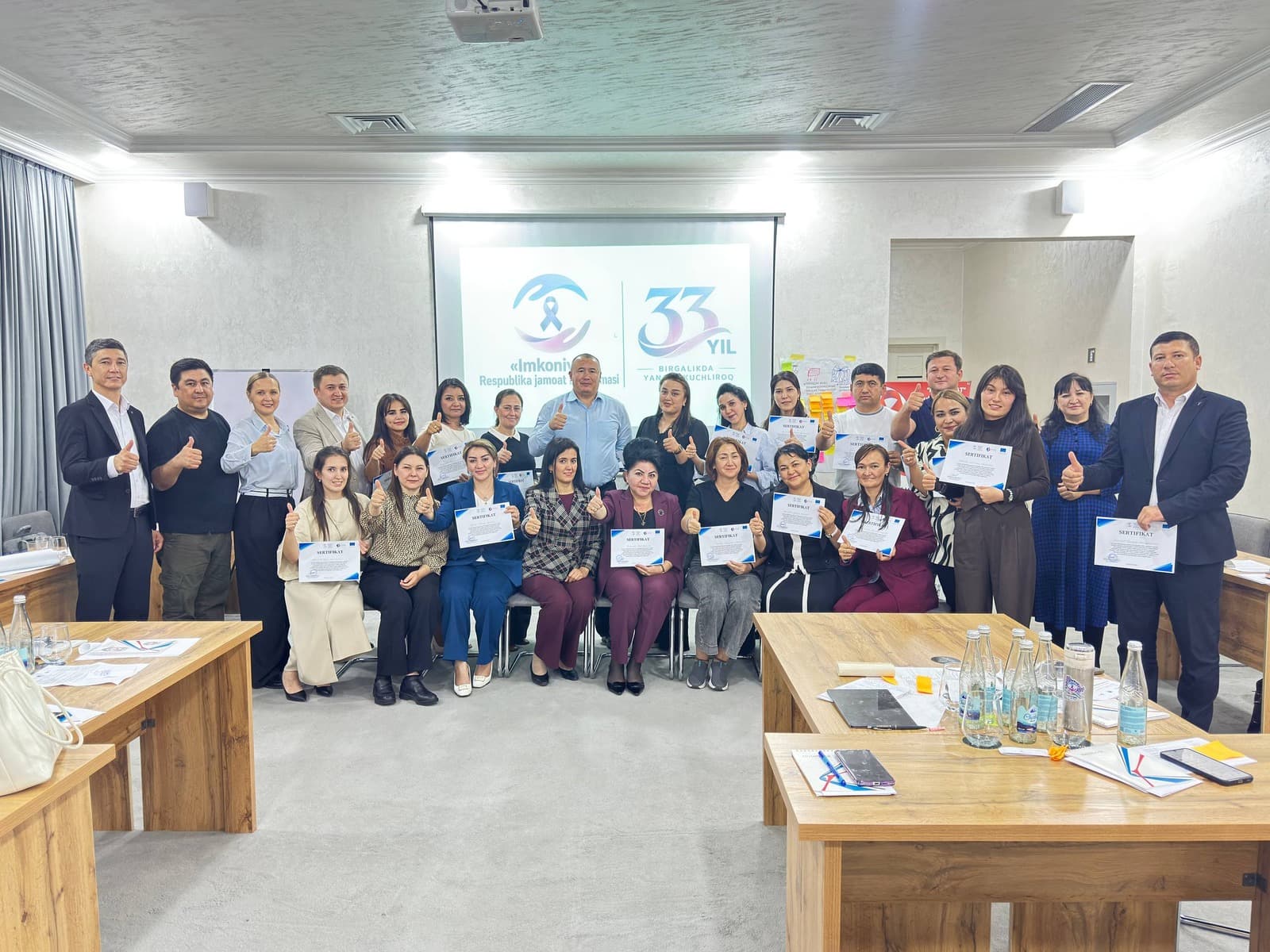
Participants in the two-day training for higher education representatives, 8–9 October 2026, Porto Bello Hotel, Tashkent. © IMKONIYAT
On 8–9 October 2026, at the Porto Bello Hotel in Tashkent, the Tashkent regional branch of the Imkoniyat Republican Public Association held a two-day training as part of the AFEW International sub-project “Achieving sustainable changes in young people’s tolerance towards people living with HIV through quizzes”.
Representatives of higher education institutions from the city of Tashkent and the Tashkent, Samarkand, Namangan and Fergana regions took part. The training aimed to increase knowledge about HIV, develop practical skills for prevention and educational work with young people, and build a tolerant attitude towards people living with HIV.
Over the two days, participants examined key issues related to HIV, including transmission routes, prevention and treatment. Particular attention was given to the rights of people living with HIV, stigma and discrimination, and ways to prevent them.
An important part of the programme was a discussion of sympathy and empathy, their role in building respect for others, and the development of a culture of mutual understanding. Participants also worked in groups, exchanged experience and discussed practical approaches to creating a safe and inclusive educational environment.
The training helped participants broaden the knowledge and practical skills they need to carry out educational work among young people. The knowledge gained can be used to raise students’ awareness of HIV, prevent stigma and discrimination, and promote equality and non-discrimination in educational settings.
At the end of the training, participants received certificates.
This initiative was an important step in strengthening cooperation with higher education institutions and promoting scientifically grounded information about HIV, respect for human rights, and tolerance towards people living with HIV. Holding a training of this kind represents a new experience for Uzbekistan and creates further opportunities to develop a systematic approach to educating young people, preventing stigma and discrimination, and building an inclusive educational environment.